
Link to Article:
https://innovations.bmj.com/content/7/2/297
Short Summary:
This study highlights the critical role of SafeBVM’s Sotair device in enhancing manual ventilation when mechanical ventilators are unavailable. Conducted during a period when there were concerns of ventilator shortages, the study assessed the effectiveness of manual ventilation with and without the Sotair device over extended periods.
Key Findings:
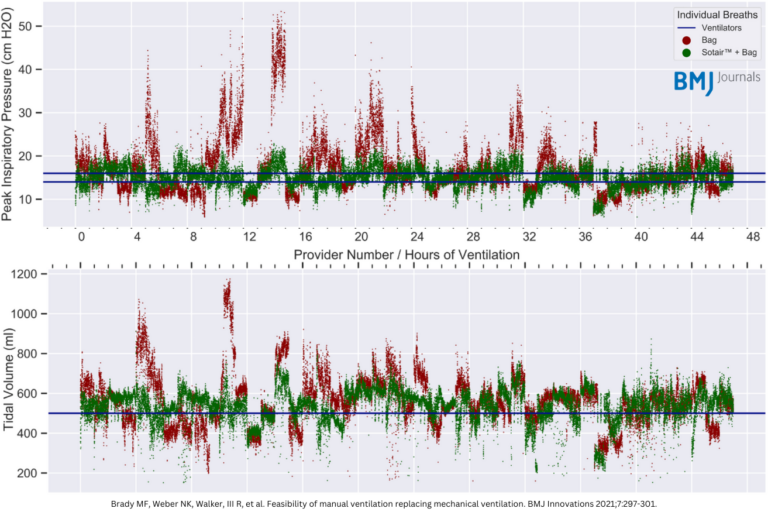
- Reduced Risk of Barotrauma: The Sotair device significantly lowered peak inspiratory pressures (14.9 cm H₂O vs. 17.2 cm H₂O without Sotair, p<0.0001), reducing the risk of ventilator-induced lung injury.
- Improved Tidal Volume Control: Manual ventilation with the Sotair device resulted in more consistent tidal volumes (mean (+SD) Vt of 536+81 with Sotair vs 565+129 ml without Sotair), mitigating risks of over- and under-ventilation.
- Feasibility for Extended Use: The study confirmed that manual ventilation with Sotair is a viable alternative in critical situations, providing a safer and more controlled method for delivering ventilation compared to traditional manual resuscitation.
Conclusion:
The Sotair device bridges the gap between manual and mechanical ventilation, optimizing safety and performance. By limiting excessive pressures and ensuring consistent tidal volumes, the device enhances the quality of manual ventilation. This research underscores Sotair’s potential to improve patient care while reducing risks associated with traditional bag-valve-mask ventilation.
Reference:
Brady MF, Weber NK, Walker III R, Holley JE, Ni SA, Young S, Monhollon ED, Carpenter RS, Tsao JW. Feasibility of manual ventilation replacing mechanical ventilation. BMJ Innov. 2021;0:1-5. doi:10.1136/bmjinnov-2020-000524.