
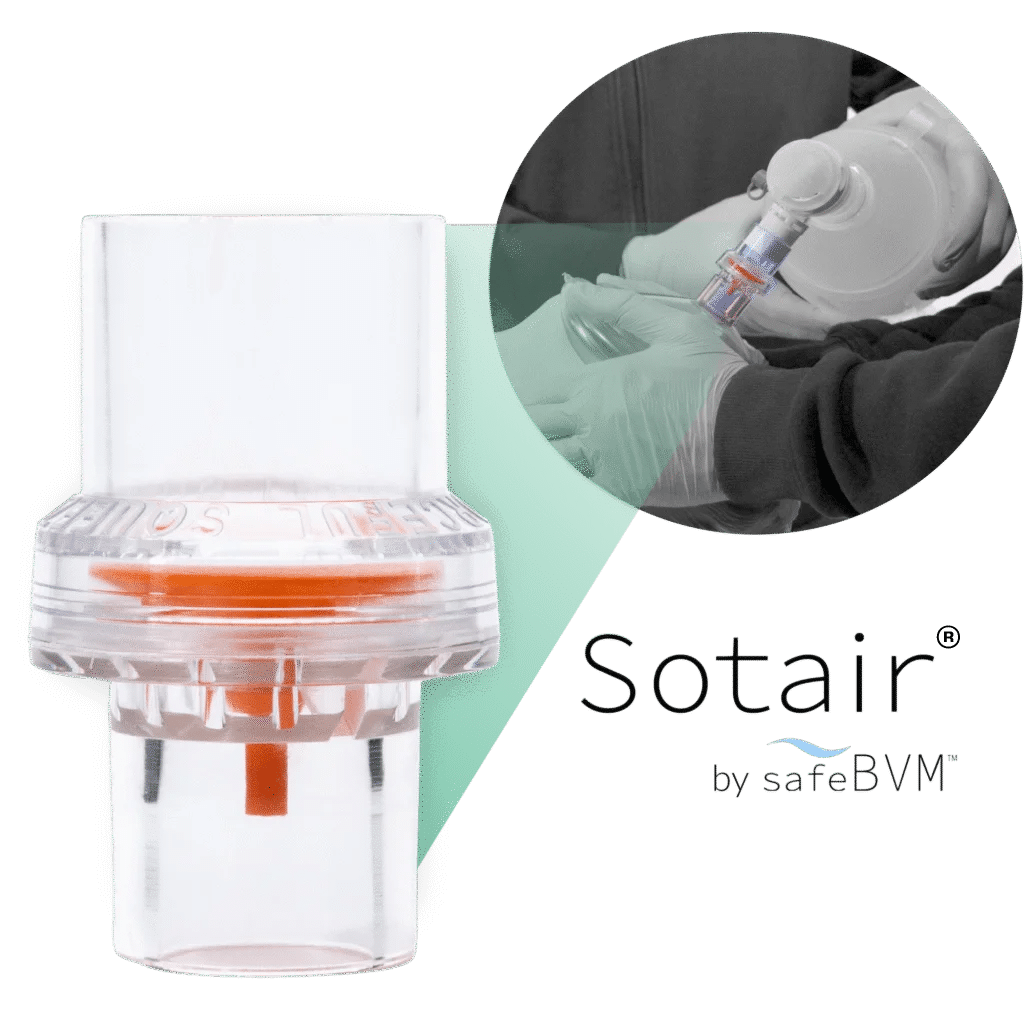
SafeBVM’s flagship innovation, the award-winning Sotair® device, is primarily funded by grants and contracts from the National Institutes of Health (NIH), the National Science Foundation (NSF), and the U.S. Military.
Sotair is a small, lightweight, easy-to-use flow control valve that fits between a manual resuscitator and a patient mask or airway. The valve prevents inspiratory flow rates from exceeding 55 LPM during manual ventilation, helping keep air delivery within safer limits without added cognitive load—no dials, screens, or additional equipment—allowing providers to stay focused on the patient.
By regulating flow, Sotair helps reduce peak airway pressures, excessive tidal volumes, and excessive breath delivery rates, minimizing the risk of over-pressurization, overventilation, and hyperventilation.
Sotair’s user-friendly design requires approximately 30 seconds of training and provides multi-sensory feedback (haptic, auditory, and visual) to guide providers in real time—improving consistency and reducing variability during manual ventilation.
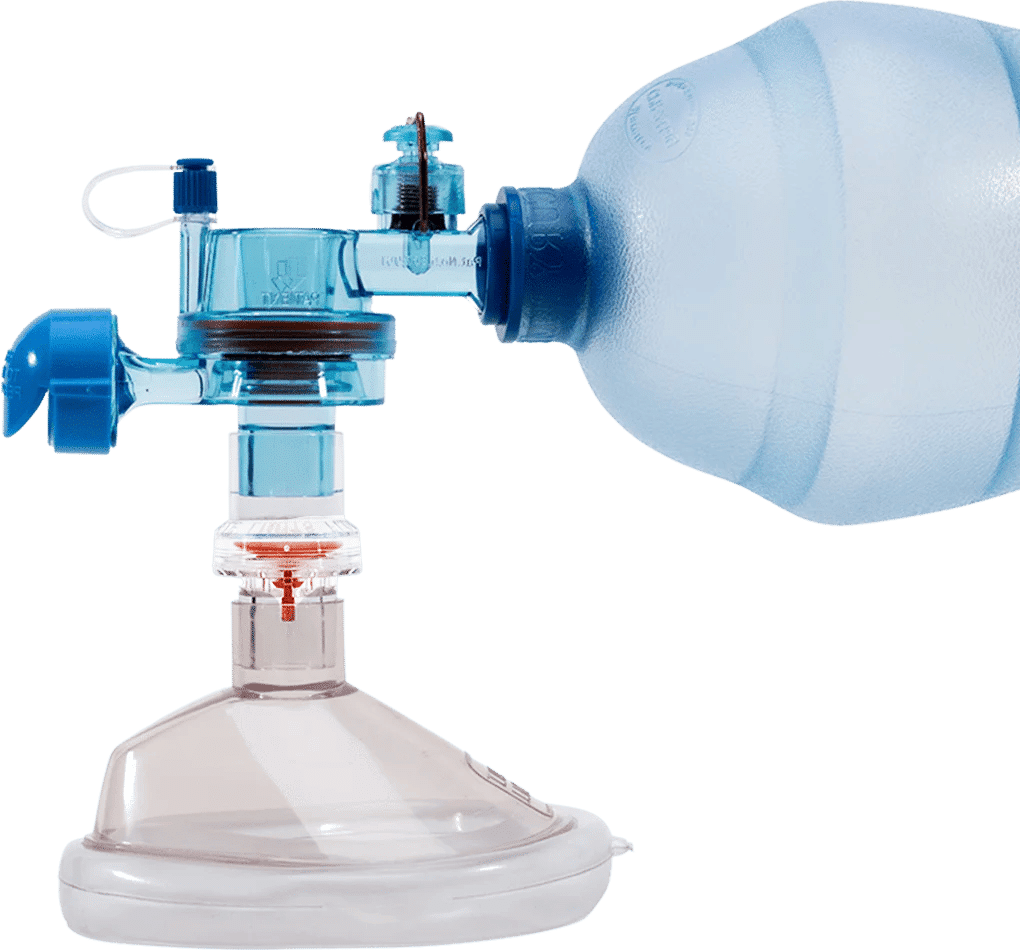
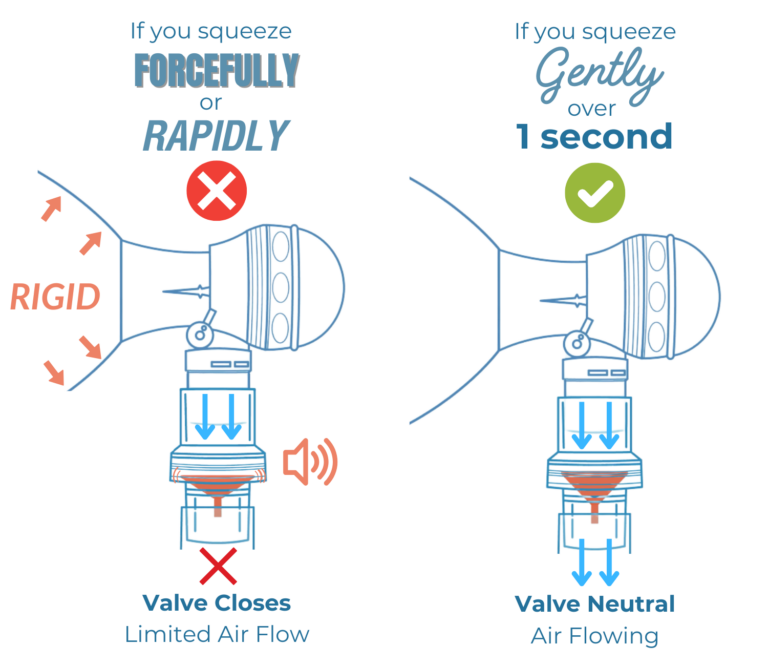
If a manual resuscitator is squeezed too fast or too forcefully and flow exceeds 55 LPM, Sotair’s valve closes, creating resistance and triggering tactile and auditory feedback alarms with visual cues. This feedback helps the provider correct their squeeze and deliver ventilation tailored to the patient’s lung condition.
Sotair has a fixed inspiratory flow limit of approximately 55 LPM, but the pressure delivered to the patient is patient-dependent, varying with lung compliance and airway resistance.
In an average adult with healthy lungs, this flow limit typically corresponds to peak airway pressures around ~20 cmH₂O. In disease states such as COPD, asthma, or ARDS—where lung compliance is reduced and/or airway resistance is increased—higher peak pressures (often in the 20–30+ cmH₂O range) may be required to deliver effective ventilation.
Unlike traditional pressure-relief (pop-off) valves, which vent gas when higher pressure is needed—such as during airway obstruction or chest compressions—Sotair® preserves delivered volume while keeping pressures within safer limits.
When used with supraglottic airways, this controlled pressure delivery helps maintain the airway seal, improving ventilation safety while bringing SGAs closer to a functional definitive airway.
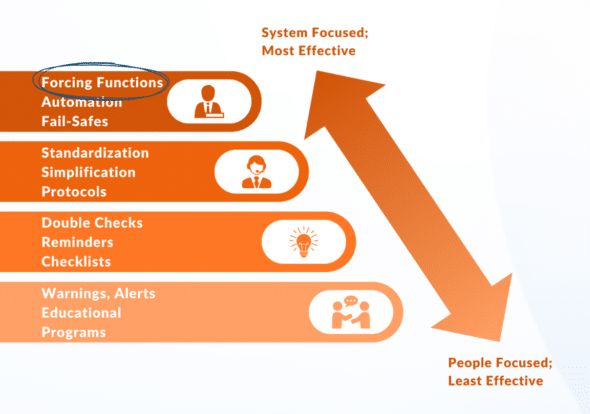
By acting as a ‘forcing function,’ Sotair® forces the right actions, avoiding rapid, forceful squeezes that lead to overventilation.
During the COVID-19 pandemic, a ventilator shortage was anticipated, making manual ventilation a potential alternative. 47 volunteers completed two one-hour manual ventilation sessions, randomized to start with or without Sotair.
Sotair reduces variability in manual ventilation, bringing performance closer to mechanical ventilators.
Authors concluded that extended manual ventilation may be feasible with a safety device, which may reduce barotrauma, underventilation and overventilation.7
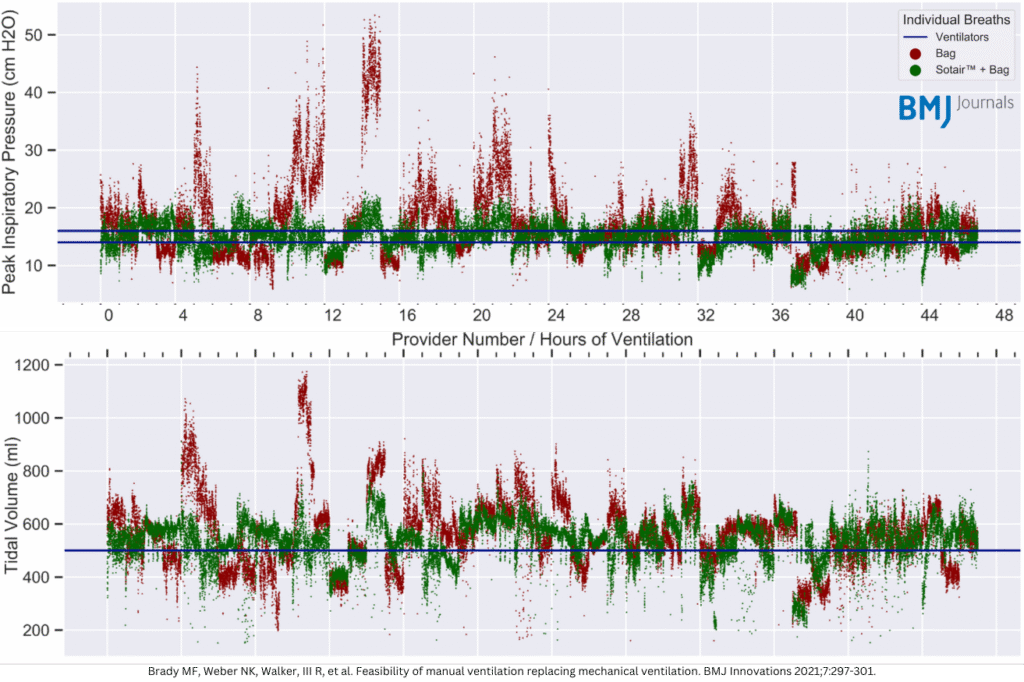
Peak pressures (p < .0001) and tidal volumes (p < .0001) were significantly improved with the Sotair® device.
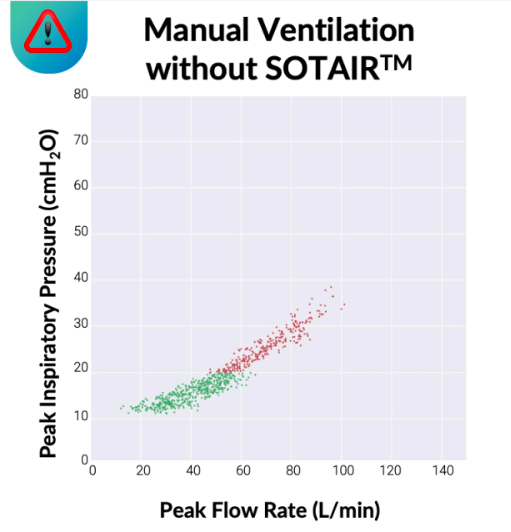
Grant 1U54HL143541 (NHLBI) funded a 40-provider pilot bench evaluation of Sotair® with North Providence Fire Station. Implementation of Sotair® showed a 36% improvement in manual ventilation.11

Sotair® flow-limited manual ventilation, with sources.
Sotair® is a single-use, inline flow-limiting device that attaches between a standard bag-valve mask and the patient. It caps the flow of every manual breath so pressure and volume stay within a safe range automatically, with no dials, no screens, and no change to technique. The Adult Sotair® device received FDA 510(k) clearance in August 2022 and is also approved by Health Canada.
Source: FDA 510(k) K212905 — Sotair Device, Safe BVM Corporation
A pop-off valve vents gas to the atmosphere once a set pressure is reached, so the patient loses part of that breath — often at the exact moment higher pressure is needed, such as with poor lung compliance, an obstructed airway, or during chest compressions. Sotair® works differently: it limits inspiratory flow, which lowers peak airway pressure while preserving the delivered tidal volume.
Source: Barnes TA, Ward JJ. Limiting Gastric Inflation. Respiratory Care 2018;63(5):635–636
Peak airway pressure rises with inspiratory flow, and the risk of forcing air into the stomach rises with pressure. In a study of positive-pressure ventilation via laryngeal mask airway, gastroesophageal insufflation occurred in 2.1% of patients at 15 cm H₂O and in 35.4% at 30 cm H₂O. By capping flow, Sotair® is designed to keep peak pressures below the range where gastric insufflation becomes common.
Source: Devitt JH, Wenstone R, Noel AG, O’Donnell MP. The laryngeal mask airway and positive-pressure ventilation. Anesthesiology 1994;80(3)
Yes. The Adult Sotair® device received FDA 510(k) clearance on August 18, 2022 under K212905, product code BTM (manual emergency ventilator / resuscitator). Sotair® is also approved by Health Canada.
Source: FDA 510(k) Premarket Notification database — K212905
Yes. A prospective randomized cross-over clinical trial compared the Adult Sotair® device attached to a manual resuscitator against manual ventilation alone in patients undergoing non-emergent surgery under general anesthesia, sponsored by Rhode Island Hospital. The trial is registered as NCT06261619 and results were presented at the European Resuscitation Council Congress 2025.
Source: ClinicalTrials.gov — NCT06261619
The 2025 American Heart Association Guidelines for CPR and Emergency Cardiovascular Care call for delivering enough tidal volume to produce visible chest rise while avoiding both hypoventilation and hyperventilation. Delivering that consistently by hand, under stress, is the hard part — and international reviews have found that ventilation quality in the field is rarely measured. Sotair® is designed to keep each breath inside that target range without adding a step for the provider.
Sources: AHA 2025 Guidelines, Part 7: Adult Basic Life Support · Debaty G, et al. Real-time ventilation quality feedback devices in OHCA: a scoping review. Resuscitation Plus 2025 (ILCOR BLS Task Force)
About 30 seconds. Sotair® fits the standard bag and mask already in service and requires no settings, no display, and no protocol change. For services that want to measure and document ventilation competence, SotairIQ™ provides real-time feedback on flow, pressure, volume, rate, and inspiratory time in training.
Sotair® is a prescription medical device. Refer to the Instructions for Use for indications, contraindications, warnings, and precautions. SotairIQ™ is intended for training and education use.