
Link to Article:
https://doi.org/10.1080/10903127.2024.2425372
Short Summary:
This study compared the SafeBVM Sotair flow-regulating safety device against traditional pop-off valves (set at 25 cmH₂O and 40 cmH₂O) when forceful breaths were delivered to mechanical test lungs simulating healthy and disease-state conditions.
Key Findings:
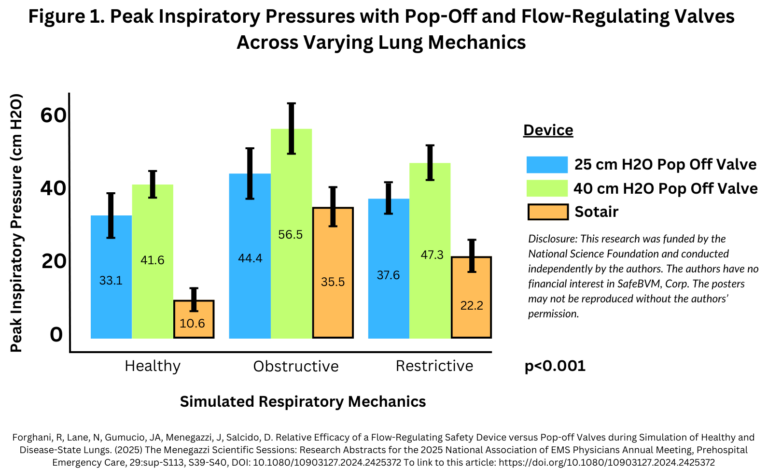
- The Sotair device consistently maintained lower and safer peak inspiratory pressures (PIP) than the pop-off valves across all conditions.
- Healthy lungs: 10.6 cmH₂O (Sotair) vs. 33.1 cmH₂O (25 cmH₂O valve) and 41.6 cmH₂O (40 cmH₂O valve).
- Obstructive disease: 35.5 cmH₂O (Sotair) vs. 44.4 cmH₂O (25 cmH₂O valve) and 56.5 cmH₂O (40 cmH₂O valve).
- Restrictive disease: 22.2 cmH₂O (Sotair) vs. 37.6 cmH₂O (25 cmH₂O valve) and 47.3 cmH₂O (40 cmH₂O valve).
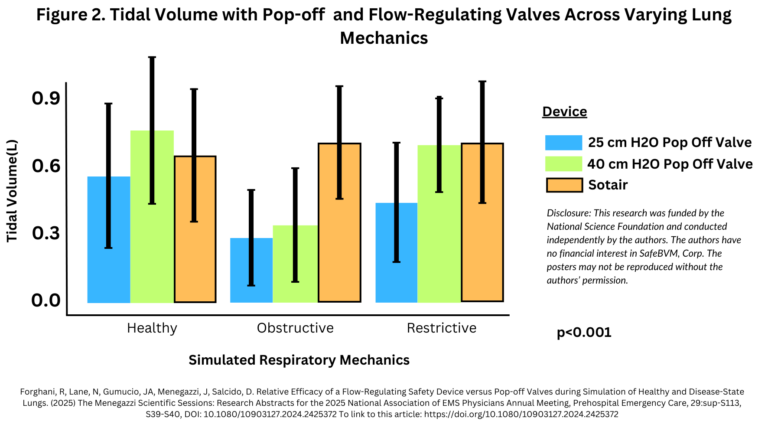
- Sotair provided controlled and effective tidal volumes (TV) while preventing excessive pressures, ensuring adequate ventilation in all lung conditions.
- Pop-off valves often failed to release at designed pressures, reducing their reliability in prehospital settings.
Conclusion:
Pop-off valves inconsistently released at the set pressures, often resulting in higher-than-anticipated inspiratory pressures. In contrast, Sotair delivered consistent tidal volumes across healthy, restrictive, and obstructive conditions. Additionally, the flow-regulating device maintained tidal volumes at lower peak inspiratory pressures in all conditions.
Reference:
Forghani, R, Lane, N, Gumucio, JA, Menegazzi, J, Salcido, D. Relative Efficacy of a Flow-Regulating Safety Device versus Pop-off Valves during Simulation of Healthy and Disease-State Lungs. (2025) The Menegazzi Scientific Sessions: Research Abstracts for the 2025 National Association of EMS Physicians Annual Meeting, Prehospital Emergency Care, 29:sup-S113, S39-S40, DOI: 10.1080/10903127.2024.2425372