
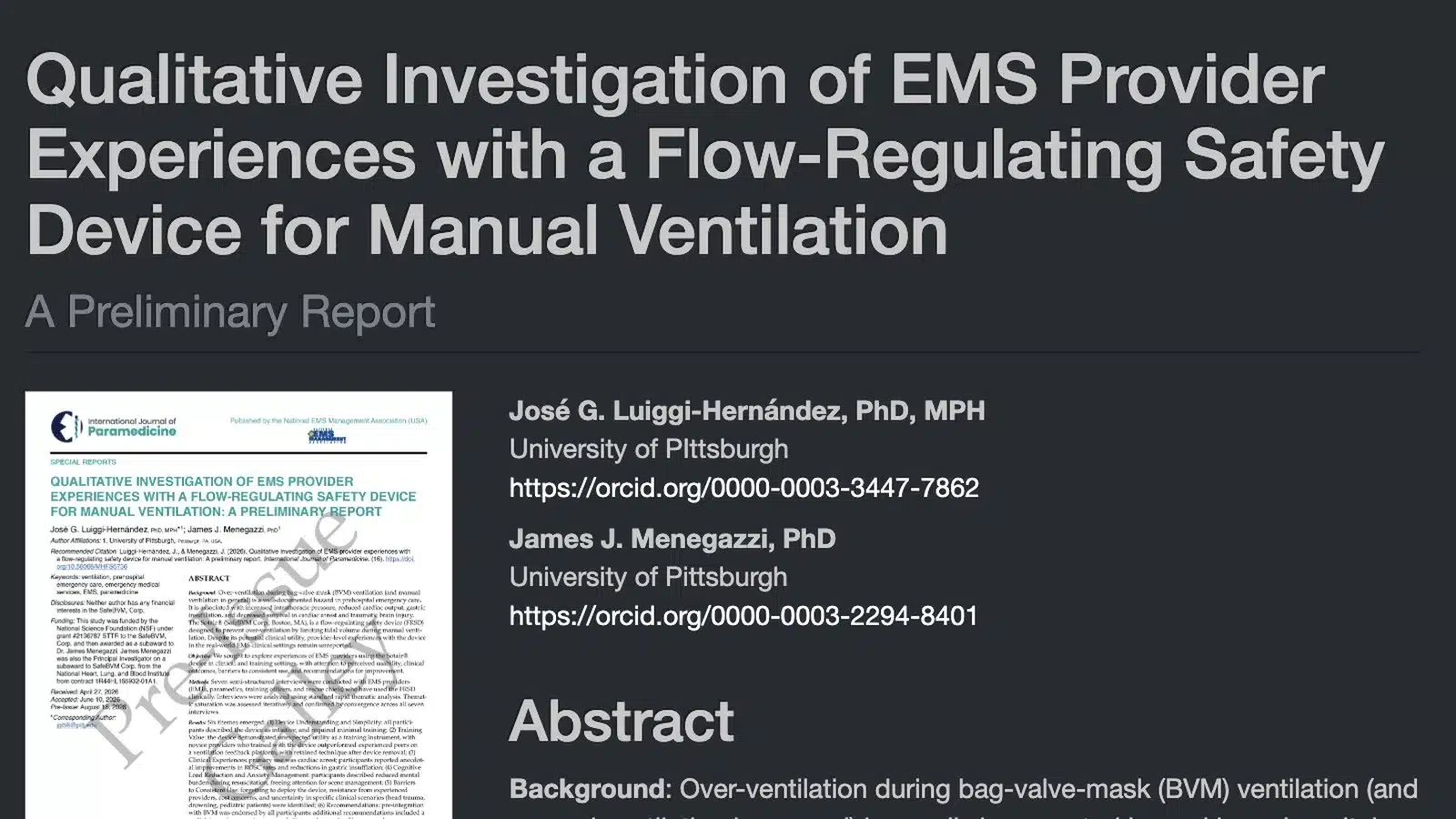
Peer-ReviewedInternational Journal of ParamedicineQualitative Study
Link to Article
Read the Full Article · Int J Paramedicine →
Short Summary
University of Pittsburgh researchers interviewed seven EMS providers from three agencies that had used Sotair® for at least a year. Every participant had used it on patients. Six themes emerged across all seven interviews: simplicity, value as a training tool, clinical experiences, lower cognitive load, barriers to consistent use, and recommendations. The authors call it a preliminary report and note that clinical performance was not measured.
Study Design
- Design: qualitative study using semi-structured interviews and rapid thematic analysis, adapting Braun and Clarke.
- Participants: seven EMS providers, all with direct clinical experience with the device on patients. Self-reported field uses ranged from 1 to 12-14 each.
- Recruitment: through each agency’s medical director. Approved by the University of Pittsburgh IRB. Participants received USD 100.
- Interviews: about 30 minutes each, one-on-one on Microsoft Teams. They were conducted by a study author, a University of Pittsburgh qualitative methodologist with no affiliation to the manufacturer.
Six Themes
1. Device understanding and simplicity
- Perceived simplicity was “the most recurring strength of the device endorsed by participants.”
- Multiple participants said minimal training, such as a brief explanation, was enough. One said it would take at least some medical training.
2. The device as a training tool
- One participant described novice providers who trained with Sotair outperforming experienced peers on a ventilation feedback platform (SotairIQ™). It was also reported that the novices kept their improved technique after the device was removed.
- The authors point to “durable ventilation skill in novice providers” as a secondary application worth recognizing. These are participant reports, not measured outcomes.
3. Clinical experiences
- Cardiac arrest was the primary clinical context. Participants also described respiratory arrest, opioid overdose and unresponsive patients.
- A training officer described a first responder on their first cardiac arrest receiving real-time corrective feedback through the device’s mechanism.
- Two participants described challenging scenarios. One felt frustration and hand fatigue on a 30-minute transport when the device repeatedly triggered. Another, in a complex CHF and sepsis case with “stiff lungs,” was unsure whether the device added to the difficulties. Both kept an overall positive view of the device.
4. Cognitive load and anxiety
- One participant called it “freedom of the mind to operate on the scene.”
- Others described the device turning ventilation from a conscious, effortful task into a more automatic one.
- A training officer noted being able to delegate bagging to less experienced personnel more confidently.
- One participant said anxiety rises when the valve activates unexpectedly, then eases as the provider adjusts and gains confidence.
5. Barriers to consistent use
- Forgetting to deploy the device was the most prominent barrier. Every department reporting consistent use had preloaded it onto BVMs during restocking.
- Resistance from some experienced providers.
- Cost, for high-volume services. All participants said cost would not lead them to stop using it.
- Clinical uncertainty about head trauma, drowning, pulmonary edema, aspiration risk and pediatric patients.
6. Recommendations for improvement
- Pre-integration with BVM equipment, endorsed by all participants.
- Peer-to-peer testimonials from early-adopting departments.
- Systematic research on real-world deployment rates.
- A pediatric-sized version.
“EMS providers reported consistently favorable experiences with the FRSD across clinical and training contexts.”
Luiggi-Hernández and Menegazzi, International Journal of Paramedicine, 2026. FRSD: flow-regulating safety device, here Sotair®.
The authors add that the main barrier, forgetting to attach the device under emergency conditions, “appears addressable through pre-integration with standard BVM equipment.”
Limitations
- A preliminary report with a small number of participants.
- Findings are provider experiences. The authors state that “actual clinical performance of the FRSD was not evaluated,” for example effects on ROSC rates or gastric insufflation.
- The authors call for prospective research measuring objective ventilation parameters and patient-level outcomes.
Disclosures
The study was funded by NSF STTR grant #2136787 to SafeBVM Corp., subawarded to Dr. Menegazzi at the University of Pittsburgh. The article also notes that Dr. Menegazzi was the principal investigator on a University of Pittsburgh subaward under SafeBVM’s National Heart, Lung, and Blood Institute award 1R44HL165932-01A1. The article states that neither author has any financial interest in SafeBVM Corp.
Randomized crossover trial of Sotair® in anesthetized adults, Resuscitation Plus (2026) →
Reference
Luiggi-Hernández JG, Menegazzi JJ. Qualitative investigation of EMS provider experiences with a flow-regulating safety device for manual ventilation: a preliminary report. Int J Paramedicine. 2026;(16). Special Reports. Pre-issue, August 18, 2026. Available from: internationaljournalofparamedicine.com/index.php/ijop/article/view/3693. DOI: 10.56068/MHFS6736. Open access under a CC BY-ND 4.0 license. Quoted passages are reproduced verbatim with credit to the authors.
Sotair® is FDA 510(k) cleared (K212905) for use in non-breathing adults and is intended to minimize gastric inflation during manual ventilation. Refer to the Instructions for Use for indications, contraindications, warnings and precautions. SotairIQ™ is for training and education use only. This page summarizes published research for healthcare professionals. For full methods and results, read the original article.