
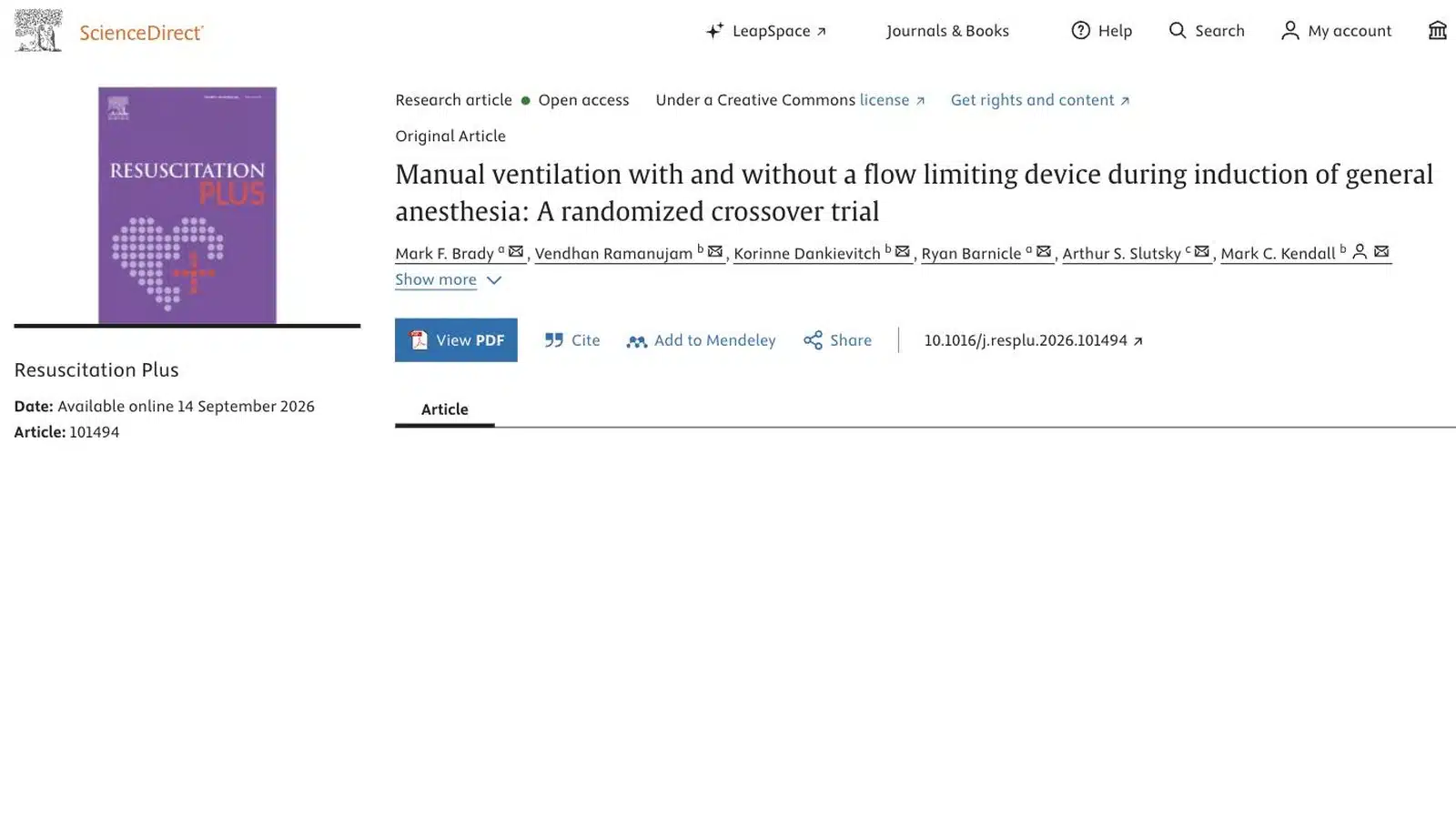
Peer-ReviewedResuscitation PlusRandomized Crossover TrialJournal Pre-proof · 2026
Link to Article
Read the Full Article · Resuscitation Plus →Trial Registration · NCT06261619 →
Short Summary
In this randomized crossover trial, 30 adults under general anesthesia were ventilated through an endotracheal tube with a self-inflating bag, with and without Sotair, in random order. During intentionally forceful breaths, Sotair lowered mean peak airway pressure from 29.6 to 18.4 cmH₂O. During non-forceful breaths, peak pressure and tidal volume did not differ significantly.
Study Design
- Setting: Rhode Island Hospital, May 2024 to March 2025. Registered as NCT06261619.
- Patients: 30 adults (ASA II) having elective surgery, studied after induction of general anesthesia and endotracheal intubation.
- Design: randomized crossover. Each patient received 3 minutes of manual ventilation with Sotair and 3 minutes with the bag alone, in random order (15 patients per sequence).
- Providers: attending anesthesiologists, anesthesia residents and CRNAs, trained beforehand. The same provider ventilated both periods.
- Forceful breaths: one intentionally forceful breath (a firm manual compression, on instruction) every 30 seconds, five per period, with non-forceful breaths in between. An adjustable pressure-limiting valve was set at 35 cmH₂O for safety.
- Primary outcome: mean peak inspiratory pressure across the five forceful breaths.
Key Findings
- Primary outcome: in forceful breaths, mean peak airway pressure was 18.4 cmH₂O with Sotair vs 29.6 cmH₂O with the bag alone. The mean difference was 11.2 cmH₂O (95% CI 10.5 to 11.9).
- Forceful breaths, secondary outcomes: peak flow was 60.1 L/min with Sotair vs 101.7 L/min with the bag alone. Tidal volume was 97 mL vs 789 mL.
- Non-forceful breaths: peak pressure (16.4 cmH₂O with Sotair vs 17.7 cmH₂O with the bag alone) and tidal volume (518 vs 542 mL) did not differ significantly. Peak flow was lower with Sotair (41.3 vs 49.4 L/min).
- Device performance: no device-related malfunctions were observed.
A Triggered Breath Is a Signal, Not Ventilation
Sotair is a single-use, passive, inline valve. When inspiratory flow exceeds about 55 L/min, a flexible flapper transiently occludes the lumen. It reopens when the bag is released, typically within 150 ms.
In this trial, forceful breaths with Sotair delivered a mean tidal volume of 97 mL. That is below the typical adult anatomic dead space of about 150 mL. The authors explain that the triggered breath is not intended to provide ventilation. Instead, the provider feels, hears and sees the feedback from the forceful breath being stopped, and it signals them to reduce compression force. They describe flow limitation from the Sotair as “a forcing function, one of the most effective types of human-factors intervention.”
Limitations
- Single center and unblinded.
- Controlled operating room with an endotracheal tube, not the prehospital setting.
- Short study periods. Clinical outcomes were not assessed.
- Anesthesia-trained clinicians and trainees, not EMS providers.
- Usability was not formally assessed.
Takeaway
Previously Presented
Early results were presented as a conference abstract at the American Society of Anesthesiologists (ASA) Annual Meeting 2025 and the European Resuscitation Council (ERC) Congress 2025 (Rapsas B, Dankievitch K, Lee E, Brady M, Kendall M). The peer-reviewed paper summarized on this page supersedes that abstract.
Disclosures
The paper states that the research did not receive any specific grant. Co-author Arthur S. Slutsky is a consultant to SafeBVM. The paper notes he had no direct role in data collection or compilation of data. See the declaration of interest in the full article for the complete statement.
Reference
Brady MF, Ramanujam V, Dankievitch K, Barnicle R, Slutsky AS, Kendall MC. Manual ventilation with and without a flow limiting device during induction of general anesthesia: A randomized crossover trial. Resusc Plus. 2026:101494. Journal pre-proof, available online September 2026. doi:10.1016/j.resplu.2026.101494. Open access under a CC BY-NC 4.0 license. As a journal pre-proof, the text may change before the final version of record.
Sotair® is FDA 510(k) cleared (K212905) for use in non-breathing adults and is intended to minimize gastric inflation during manual ventilation. Refer to the Instructions for Use for indications, contraindications, warnings and precautions. SotairIQ™ is for training and education use only. This page summarizes published research for healthcare professionals. For full methods and results, read the original article.